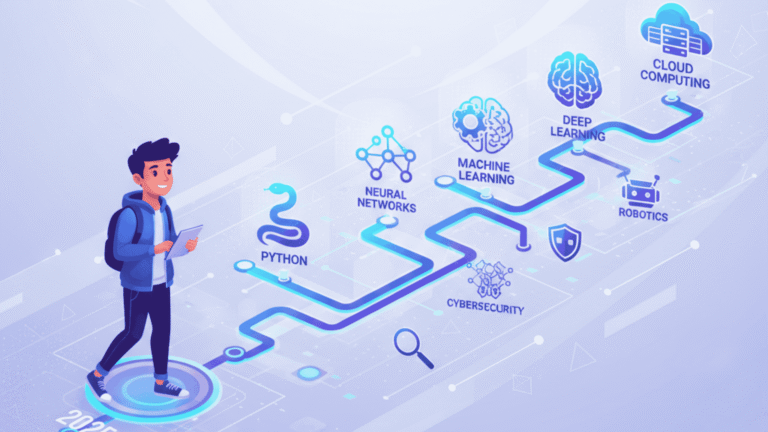
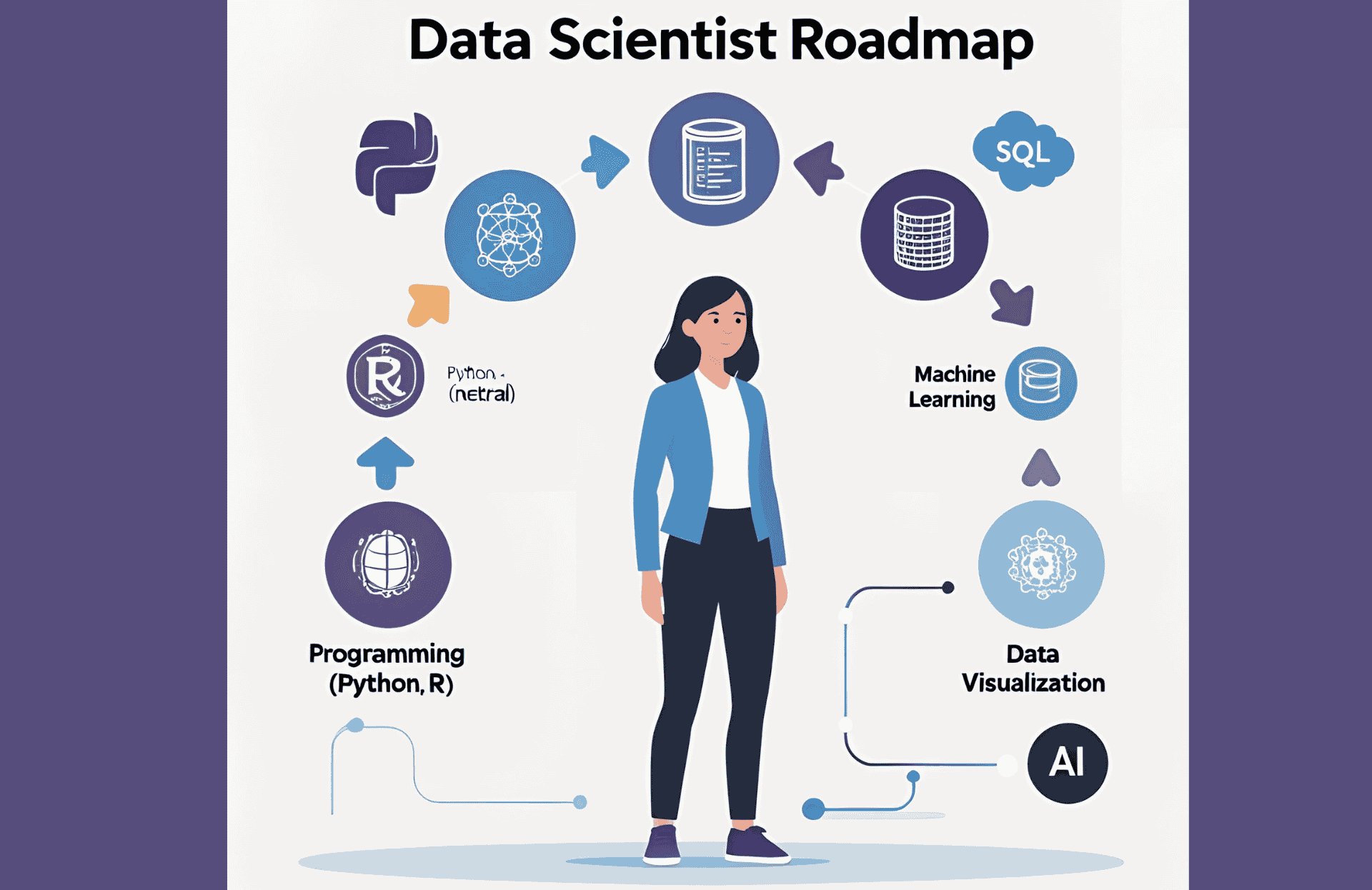
Are you planning to build a career in data science in 2025? Whether you are a fresh graduate, switching from tech, or coming from a non-tech background, this guide will give you a complete data science roadmap 2025 from beginner to advanced.
What Do Data Scientists Do?
If you are starting your journey with the data science roadmap 2025, you may wonder: What exactly does a data scientist do?
Data scientists are professionals who use data to help companies and organizations make smarter, evidence-based decisions. With the rise of AI, machine learning, and automation, the role of a data scientist has become one of the most in-demand and high-paying jobs in 2025.
Here are some ways data scientists create value across industries:
- AI & Machine Learning: They build, train, and validate models that power applications like recommendation systems, chatbots, and fraud detection.
- Business Decision-Making: By analyzing large datasets, they uncover patterns and trends that guide business strategies.
- Industry Applications: Data science is used in finance (fraud detection, stock predictions), healthcare (disease prediction, patient monitoring), retail and e-commerce (personalized recommendations), and many more fields.
- Problem-Solving: From optimizing supply chains to predicting customer behaviour, data scientists ensure companies stay competitive in a data-driven world.
In short, data scientists bridge the gap between data and decision-making, turning raw numbers into insights that drive growth and innovation.
Core Responsibilities of a Data Scientist
If you are following the data science skills, it’s important to understand what data scientists actually do. These responsibilities form the foundation of a successful data science career path:
- Collect & Clean Data
Data scientists gather information from sources such as APIs, databases, websites, or IoT sensors. Cleaning and preparing this raw data is the first step toward building accurate insights. - Analyze Data
Using statistics, mathematics, and visualization techniques, data scientists identify trends, relationships, and hidden patterns. This analysis helps businesses make data-driven decisions. - Build Models
One of the key data scientist responsibilities is creating machine learning models. These models are trained to solve problems like predicting customer behavior, detecting fraud, or forecasting demand. - Interpret Results
A model’s output is usually numbers or probabilities. Data scientists translate these technical results into simple business insights so that managers and decision-makers can act on them. - Deploy Solutions
Data science doesn’t stop at building models. Professionals also integrate these solutions into real-world systems, such as mobile apps, websites, or automated reporting pipelines. - Communicate Insights
Data scientists create dashboards, reports, and visualizations to explain their findings clearly. Effective communication is what turns complex data into actionable strategies.
“This roadmap for 2025 is divided into four phases: beginner, intermediate, advanced, and portfolio, Interview preparation. Each phase covers the essential skills you need and suggests a realistic timeframe to complete them. Let’s go step by step.”
Timeframe to become Data Scientists:
| Phase | Duration | Focus Area |
| Phase 1 | 1–3 Months | Foundations (Math, Python, SQL) |
| Phase 2 | 3–6 Months | Core Skills (Data Wrangling, ML Basics) |
| Phase 3 | 6–12 Months | Advanced Topics (Deep Learning, Big Data, Cloud) |
| Phase 4 | 3–6 Months | Job Readiness (Portfolio, Interviews, Freelancing) |
Phase 1: Basics (Mathematics, Programming)
Mathematics:
Math is the foundation of data science because it explains how models work, why they succeed, and when they fail. Concepts from linear algebra, calculus, and probability power algorithms, feature engineering, evaluation metrics, and optimization methods like gradient descent. Beyond calculations, math builds critical thinking—helping detect false patterns, avoid overfitting, and validate results. In short, it turns you from a simple “model user” into a true “model creator.”
Here’s the Math You Need for Data Science in 2025
1. Linear Algebra (for data representation & ML algorithms)
- Vectors & Matrices – addition, multiplication, transpose
- Matrix Operations – inverse, determinants
- Dot Product & Cross Product
- Eigenvalues & Eigenvectors – for PCA, dimensionality reduction
2. Calculus (for optimization & learning algorithms)
- Derivatives & Gradients – single and multivariable
- Partial Derivatives – used in gradient descent
- Chain Rule – important for backpropagation in deep learning
- Integration Basics – less common, but useful in probability
3. Probability (for predictions & uncertainty)
- Basic Probability Rules – addition, multiplication
- Conditional Probability & Bayes’ Theorem – Naive Bayes classifier
- Probability Distributions – Normal, Binomial, Poisson, Uniform
- Random Variables & Expectation
4. Statistics (for data analysis & inference)
- Mean, Median, Mode, Variance, Std. Deviation
- Hypothesis Testing – t-test, chi-square test
- Confidence Intervals
- Correlation & Covariance
- p-values & Significance
5. Discrete Mathematics (for algorithms & logic)
- Sets & Functions
- Combinatorics – permutations, combinations
- Graph Theory Basics – networks, trees
Recommended Paid Courses to Learn Math for Data Science
If you want structured and practical guidance, here are some top-rated paid options:
- Mathematics for Machine Learning and Data Science (DeepLearning.AI, Coursera) – Covers linear algebra, calculus, and probability with ML-focused examples.
- Data Science Math Skills (Duke University, Coursera) – Beginner-friendly, focused on statistics and probability essentials.
- Mathematics: Basics to Advanced for Data Science & GenAI (Udemy) – A complete, budget-friendly package covering all essentials.
- Fundamental Math for Data Science (Codecademy Pro) – Interactive browser-based learning with quizzes and projects.
- Math Fundamentals for Data Science & ML (Anaconda Certified) – A specialized program with applied examples in Python.
- Harvard Professional Certificate in Data Science (edX) – Includes R programming, probability, statistics, and modeling, taught with academic rigor.
Programming:
Programming is a vital part of learning data science because it provides the tools to perform every step of the workflow from start to finish. Since data is rarely clean or ready to use, languages like Python and R are essential for collecting information from databases, websites, or APIs, and for cleaning, preprocessing, and transforming messy real-world data into usable formats. With programming, we can reshape, filter, and combine datasets for analysis. It also plays a central role in modeling and analysis, where code is used to build and test AI models, run statistical analysis, and apply machine learning algorithms through libraries such as Scikit-learn and TensorFlow. Moreover, programming enables automation of repetitive tasks, saving time and reducing errors. Finally, it is the key to visualization and communication—using libraries like Matplotlib or ggplot2 to create charts and graphs, and even building dashboards or interactive applications to present insights in a clear and engaging way.
Languages & Skills to Learn:
Python (primary language for data science)
- Why: Simple syntax, huge libraries for data (NumPy, Pandas, Scikit-learn, TensorFlow).
- Topics:
- Variables, Loops, Functions, Classes (OOP basics)
- List/Dict/Set comprehension
- File I/O
- Working with APIs
- Example: Automating a CSV cleanup with Pandas in 3 lines of code.
R (for statistics & visualization)
- Why: Excellent for statistical modeling, quick plots with ggplot2.
- Example: Running a linear regression in one line.
SQL (for working with databases)
- Why: 80% of a data scientist’s work involves extracting data.
- Topics: SELECT, WHERE, JOIN, GROUP BY, HAVING, Subqueries, Window Functions.
- Example: Writing a query to find the top 5 customers by revenue.
Version Control (Git/GitHub)
- Learn about git Repository.
Recommended Paid Courses to Learn Programming for Data Science
If you’re serious about mastering programming for data science, here are some excellent paid options that combine structured learning with industry-recognized certificates:
Harvard Professional Certificate in Data Science (edX) – More academic and statistics-oriented, ideal if you want university-level rigor.
IBM Data Science Professional Certificate (Coursera) – Beginner-friendly track covering Python, SQL, and ML basics with a strong career focus.
Programming for Data Science with Python (Udacity Nanodegree) – Hands-on projects in Python, SQL, Git, and data wrangling, with mentor support.
365 Data Science Subscription – Affordable video-based learning, covering Python essentials and practical business cases.
DataCamp – Interactive, browser-based Python and SQL coding practice with instant feedback.
Dataquest – Project-based learning in Python, R, and SQL with a structured roadmap.
Udemy Bootcamps – Budget-friendly, lifetime-access courses like Complete Python for Data Science and Machine Learning.
Phase 2: Core Data Science Skills:
In this phase, you are ready to work with real-world data and start building machine learning models. You will do Hands-on data work, a data scientist spends 80% of the time on cleaning, transforming data before modeling. Mastering Pandas, SQL, and visualization makes you good at this. Turning Raw Data into Perception EDA(Exploratory data analysis) is used to drive business decisions. Start building models for predictive analytics. You will learn to connect datasets, choose the right ML algorithm and evaluate results.
Topics to Cover in Phase 2
Pandas (Python library)
- Reading/writing data (CSV, Excel, SQL)
- DataFrames & Series
- Filtering, sorting, indexing
- Handling missing values & duplicates
- GroupBy & Aggregation
- Merging & Joining datasets
- Feature engineering basics (new columns, scaling, encoding)
SQL (Databases)
- SELECT, WHERE, ORDER BY
- JOINs (INNER, LEFT, RIGHT, FULL)
- GROUP BY & HAVING
- Aggregate functions (COUNT, AVG, SUM, MAX, MIN)
- Subqueries & Nested queries
- Window functions (ROW_NUMBER, RANK, PARTITION BY)
- Practice with PostgreSQL/MySQL
Exploratory Data Analysis (EDA)
- Handling missing values & outliers
- Data distributions
- Correlation analysis (heatmaps)
- Trend spotting
- Feature relationships (pair plots, scatter plots)
Data Visualization Tools
- Matplotlib – low-level plotting (line, bar, histograms)
- Seaborn – statistical visualization (pairplot, heatmap, boxplot)
- Plotly – interactive dashboards and visualizations
Supervised Learning
- Linear Regression
- Logistic Regression
- Decision Trees
- Random Forests
- Support Vector Machines
- K-Nearest Neighbors
Unsupervised Learning
- K-Means Clustering
- Hierarchical Clustering
- Principal Component Analysis
Model Evaluation Metrics
- Classification: Accuracy, Precision, Recall, F1-score
- ROC & AUC
- Confusion Matrix
- Regression: MSE, RMSE, R²
Scikit-Learn (ML Library)
- Train-test split
- Implementing models (fit, predict, score)
- Cross-validation
- Hyperparameter tuning (GridSearchCV, RandomizedSearchCV)
- Pipelines
Recommended Paid Courses for Phase 2
Here are some excellent paid options to master Data Analysis + Machine Learning:
🔹 Data Manipulation & Analysis
- Applied Data Science with Python Specialization (University of Michigan, Coursera) – Focused on Pandas, Matplotlib, and data visualization.
- Data Analyst with Python (DataCamp Career Track) – Hands-on practice with Pandas, SQL, and Seaborn inside the browser.
- SQL for Data Science (UC Davis, Coursera) – Covers SQL basics to advanced queries, including joins and window functions.
- The Complete SQL Bootcamp (Udemy) – Bestseller course for PostgreSQL and MySQL queries.
🔹 Machine Learning Fundamentals
- Machine Learning by Andrew Ng (Coursera, Stanford/DeepLearning.AI) – Classic ML course covering supervised & unsupervised algorithms.
- Hands-On Machine Learning with Scikit-Learn & TensorFlow (Book + Udemy companion courses) – Practical, code-heavy ML learning.
- Intro to Machine Learning with PyTorch or Scikit-Learn (Udacity Nanodegree) – Project-based ML program with mentor feedback.
Machine Learning A-Z: Hands-On Python & R in Data Science (Udemy) – Covers regression, classification, clustering, and evaluation metrics.
Phase 3: Advanced Topics & Projects (6–12 Months)
At this stage, you have already learned Data handling, analysis, and basic machine learning. Now the time starts to go beyond fundamentals to specialize in your expertise. Deep Learning & AI makes you work on cutting-edge applications like NLP(ChatGPT-like models), image recommendation, and recommendation systems. Big data & cloud help you handle real-world datasets that don’t fit in laptop memory. Portfolio building through projects provides evidence of your skills to employers, GitHub, and Kaggle.
This phase transforms you from a learner into a job-ready data scientist.
Deep Learning & AI (Optional but Highly Valuable)
Topics to Cover:
- Neural Networks: Perceptron, activation functions, backpropagation.
- Deep Learning Frameworks: TensorFlow, PyTorch, Keras.
- Computer Vision: Convolutional Neural Networks (CNNs), object detection, image classification.
- Natural Language Processing (NLP): Word embeddings, transformers, BERT, GPT, sentiment analysis.
- Transfer Learning & Fine-Tuning: Pretrained models for faster development.
Big Data & Cloud Computing
Topics to Cover:
- Big Data Tools: Apache Spark, Hadoop.
- Cloud Platforms: AWS (SageMaker, Redshift), Google Cloud (BigQuery, AI Platform), Azure ML.
- Deployment & Scaling: Docker (containerization), Kubernetes (orchestration).
- Data Pipelines: ETL (Extract, Transform, Load), Airflow.
Recommended Paid Courses for Phase 3
- Deep Learning Specialization – Andrew Ng (Coursera)
Covers neural networks, CNNs, RNNs, and real-world AI projects. - Deep Learning with PyTorch (Udemy)
Hands-on coding-focused course for building deep learning models. - NLP Specialization (Coursera – DeepLearning.AI)
Focuses on BERT, Transformers, and NLP pipelines. - Big Data with PySpark (Udemy/Datacamp)
Teaches distributed data processing with Spark. - AWS Certified Machine Learning Specialty (Coursera/Udemy)
Cloud ML workflows with AWS SageMaker. - Docker & Kubernetes for Data Science (Udemy)
Deployment and scaling skills for real-world ML.
Kaggle Micro-Courses + Portfolio Projects
Phase 4: Job Readiness (3–6 Months)
Once you have the technical foundation, the next step is preparing yourself for real-world opportunities. This phase focuses on building a strong portfolio, improving communication skills, and stepping into the job market with confidence.
1. Build a Strong Portfolio
Employers want to see how you apply your skills to solve real problems. Focus on creating 2–3 solid projects and showcasing them effectively.
- Kaggle Competitions: Start with beginner-friendly challenges such as Titanic Survival, House Prices, or Image Classification. These help you practice structured problems.
- Personal Projects: Go beyond Kaggle and work on end-to-end workflows using real-world data. Examples:
- Housing price prediction (Regression)
- Sentiment analysis on Twitter/Reddit data (NLP)
- Image classifier for handwritten digits or objects (Computer Vision)
- GitHub Repository: Share your work with clean, well-documented code. Include detailed README files, step-by-step Jupyter notebooks, and explanations for non-technical audiences.
- Content Creation: Write tutorials or project breakdowns on platforms like Medium, Dev.to, or LinkedIn. Sharing knowledge not only strengthens your understanding but also increases visibility to recruiters.
- Portfolio Website: Bring everything together — projects, blogs, and GitHub repos — into one professional online space. You can use GitHub Pages, Notion, or WordPress to keep it simple.
2. Develop Soft Skills & Prepare for Interviews
Technical skills get you shortlisted, but communication and presentation skills help you land the job.
- Communication: Learn to explain complex technical concepts in simple terms. Imagine you’re teaching a non-technical audience.
- Resume & LinkedIn: Highlight projects, skills, and measurable outcomes. Keep it concise and impact-driven.
- Mock Interviews: Practice SQL queries, Python coding, machine learning concepts, and business case questions. Platforms like Pramp or Interviewing.io can help.
- Behavioral Interviews: Use the STAR Method (Situation, Task, Action, Result) to structure answers and demonstrate problem-solving ability.
3. Apply for Jobs & Build Your Network
Once your portfolio and resume are ready, start applying strategically.
- Entry-Level Roles: Look for positions like Data Analyst or Junior Data Scientist. These are excellent entry points.
- Freelancing: Platforms like Upwork and Fiverr can help you gain experience and build credibility.
- Networking: Actively engage on LinkedIn, attend online meetups, join data science communities, and contribute to open-source projects. Networking often leads to hidden opportunities that aren’t advertised.
End Goal of Phase 4: By the end of this stage, you should have a visible portfolio, sharpened communication skills, and a job application strategy. Whether you target a corporate role, freelance career, or research path, you’ll be ready to showcase both your technical and problem-solving skills.
Frequently Asked Questions (FAQ)
Do I need a degree to become a data scientist?
Not always. Many data scientists come from computer science, math, or statistics backgrounds, but you can also learn through online courses, bootcamps, and hands-on projects. What matters most is your skills and portfolio.
How long does it take to become a data scientist?
It depends on your background and learning pace. On average, with consistent effort, it can take 6–12 months to learn the fundamentals and start applying for entry-level jobs.
Is Python enough for data science?
Python is the most widely used language in data science because of its powerful libraries like Pandas, NumPy, and Scikit-learn. However, knowing SQL for databases and some R for statistical work can give you an edge.
What is the difference between a data analyst and a data scientist?
A data analyst focuses on interpreting existing data, generating reports, and creating visualizations. A data scientist goes a step further by building models, using machine learning, and making predictions from data.
Do I need strong math skills for data science?
Yes, but not at the level of a mathematician. You’ll need a good understanding of linear algebra, probability, statistics, and calculus to understand how models work and to build better ones
Can a beginner learn data science without a coding background?
Absolutely. Many beginners start with no coding experience. Python and R are beginner-friendly, and you can pick up coding while learning data analysis and visualization.
What are the top tools used in data science?
Common tools include Python, R, SQL, Jupyter Notebook, Excel, Tableau, Power BI, TensorFlow, and PyTorch. The choice depends on the type of work (analysis, visualization, or machine learning).
Is data science a good career in 2025 and beyond?
Yes. With the growing use of AI and data-driven decision-making, data science roles are in high demand. Companies in tech, finance, healthcare, and e-commerce are actively hiring data professionals.
How do I build a portfolio as a beginner?
Start with small projects like analyzing a public dataset, then move to Kaggle competitions or personal projects (e.g., movie recommendations, sales forecasting). Share them on GitHub and write short explanations or blogs.
Can I work as a freelancer in data science?
Yes. Platforms like Upwork, Fiverr, and Toptal have a growing demand for freelance data analysts and data scientists. Starting with smaller projects helps you gain experience and build credibility.