[Step-by-Step Guide] for students after 12th
Artificial Intelligence (AI) is no longer just a buzzword — it’s shaping industries like healthcare, finance, e-commerce, and even entertainment. Behind these innovations are AI Engineers, professionals who design, build, and deploy intelligent systems. AI is everywhere, and companies are racing to hire skilled AI Engineers. If you’re a student just out of 12th grade or a college beginner, and if you’re wondering how to become an AI Engineer in 2025, this step-by-step AI Engineer roadmap will guide you from beginner to professional.
2025 is the right time to learn AI because the demand for skilled AI engineers is higher than ever. The reason behind the demand for AI adoption is booming worldwide, from self-driving cars to ChatGPT.
Benefits of Becoming an AI Engineer
High Demand & Job Security
- AI is one of the most in-demand fields in tech.
- Finance, Health care, e-commerce, and entertainment companies are hiring AI experts.
- AI engineers are among the highest-paid tech professionals.
- Globally, average salaries are $90,000+ per year, with top engineers crossing $200,000.
- According to reports, AI jobs are growing at 30-40% annually.
- Soft skills Matter: Problem-solving, teamwork, and communication are equally important for career growth.
Wide Career Opportunities
AI engineers work in different roles according to their specialized areas of study like:
- Data Scientist
- Machine Learning Engineer
- NLP Engineer
- Computer Vision Specialist
- AI Product Manager
- Research Scientist
Continuous Learning & Growth
- AI is an evolving field, so you’ll never get bored.
- You’ll always learn new frameworks, algorithms, and innovations.
- This ensures long-term career growth
Phase 1: Learn the Basics
Before diving into advanced AI concepts, you need a strong foundation in Programming, Mathematics, and problem-solving.
Build your Math Foundation
Math is the backbone of AI. Focus on:
- Linear Algebra: vectors, matrices, Transformations
- Probability & Statistics: Distributions, mean, variance, conditional probability
- Calculus: Derivatives, gradients(important for optimization in AI models)
“You don’t need to be a math genius —Just consistent practice is enough.” Focus on applied math rather than theoretical proofs.
Learn Programming (Python)
Python is a beginner-friendly and widely used language in AI
- Basic Concepts: Variables, loops, functions, and data structures.
- Practice with libraries: NumPy, Pandas, Matplotlib for data handling and visualization.
- Practice daily on platforms like LeetCode, HackerRank, or Kaggle.
Understand Computer Science Fundamentals
AI engineers also need solid CS Knowledge:
- Data structures: trees, graphs, sorting, arrays, stacks, queues
- Algorithms: searching, sorting, recursion, dynamic programming
- Database knowledge: (SQL, NoSQL basics)
- Learn version control with Git/GitHub early — it’s essential for collaboration.
Tip: Use sites like LeetCode and HackerRank to practice problem-solving.
Phase 2: Learn AI Tools and Frameworks
Once you’re comfortable with Programming and math, then start learning AI tools,
Data Science Basics
AI starts with data. Learn how to:
- Clean and prepare data
- Analyze data with Pandas
Visualize insights using Matplotlib or Seaborn
Machine Learning (ML)
Machine Learning is the core of AI.
- Learn ML algorithms:
- Regression
- Classification
- Clustering (K-Means, DBSCAN)
Practice with Scikit-learn (Python’s ML library).
Tools & Frameworks:
- Scikit-Learn (easy to start)
- TensorFlow or PyTorch (industry-level)
Beginner Projects:
- House price prediction
- Spam email detection
- Movie recommendation system
Try deploying at least one of these models using Flask or FastAPI to learn how real-world apps integrate AI.
Master Deep Learning
Deep Learning powers modern AI applications like ChatGPT, image recognition, and self-driving cars.
Key Topics:
- Learn Neural Networks and how they work (basics & backpropagation)
- CNNs for image recognition
- RNNs & LSTMs for sequence data
- Dive into TensorFlow and PyTorch
Explore Convolutional Neural Networks (CNNs) for images and Recurrent Neural Networks (RNNs) for sequences
Tools:
- PyTorch (preferred by researchers)
- TensorFlow + Keras (production-friendly)
Projects:
- Handwritten digit recognition (MNIST)
- Image caption generator
- Chatbot with NLP
Choose a Specialization
AI is vast. Focus on one area:
- Natural Language Processing (NLP): Chatbots, sentiment analysis, text summarization
- Computer Vision: Face recognition, medical imaging, self-driving cars
- Reinforcement Learning: Robotics, game AI, optimization
- Generative AI: Image generation, music creation, large language models
While Generative AI is trending, start with basics before diving into advanced models like GPT or Stable Diffusion.
Phase 3: Build Projects
Theory is good — but projects land you jobs.
- Personal Projects → Publish on GitHub
- Kaggle Competitions → Improve problem-solving
- Internships / Freelancing → Get industry experience
- Open Source Contributions → Build credibility
Pro Tip: Create a portfolio website showcasing your AI projects. Freelancing platforms (Upwork, Fiverr) are great for finding small AI gigs and earning while learning.
Learn Deployment & MLOps
AI engineers must know how to deploy models into real-world systems.
- MLOps Basics: Model tracking, versioning (MLflow, DVC)
- Deployment Tools: Docker, Kubernetes
- Cloud Platforms: AWS, Google Cloud, Azure AI services
Learning Flask/FastAPI: will help you serve your AI models as APIs — a must-have skill for entry-level AI engineers
Stay Updated with AI Trends
AI evolves faster than any field. Stay ahead by:
- Reading research papers (arXiv, Papers with Code)
- Following AI communities (Kaggle, Reddit, LinkedIn groups)
- Taking online courses (Coursera, Udemy, fast.ai)
Follow ethical AI practices Learn about bias, fairness, and responsible use of AI models.
Suggested Roadmap Timeline
Here’s a time-based AI roadmap to stay consistent:
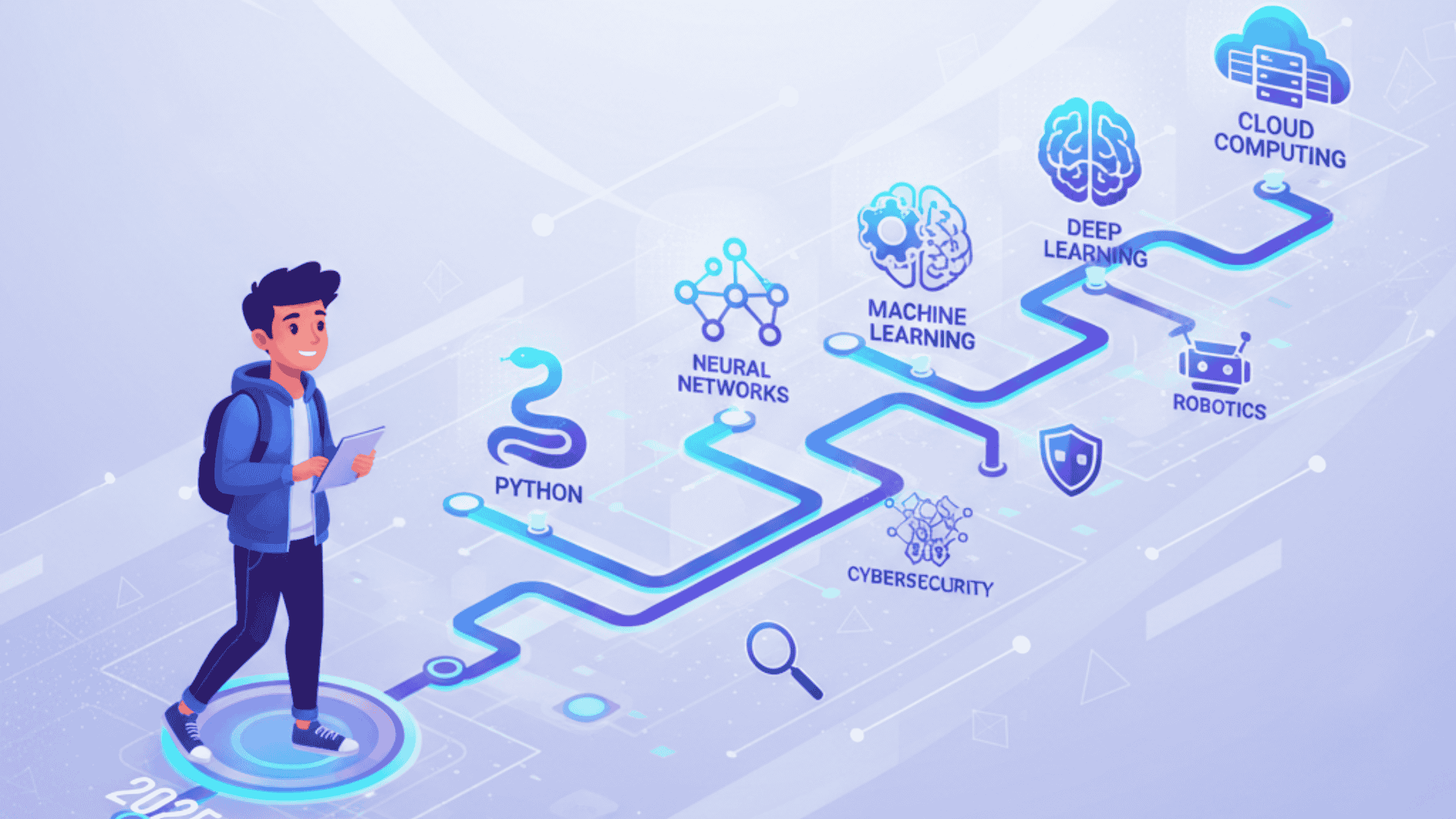
- 0–3 Months: Python + Math + Data Structures
- 3–6 Months: Machine Learning basics + projects
- 6–12 Months: Deep Learning + NLP/Computer Vision
- 12–18 Months: Specialization + real-world projects
- 18+ Months: Cloud, MLOps, advanced AI research
At this stage, you can aim for roles like Junior AI Engineer, ML Engineer, or AI Research Assistant.
Conclusion
Becoming an AI Engineer in 2025 is one of the smartest career choices you can make. With AI reshaping industries worldwide, the demand for skilled engineers is only growing.
To recap, your roadmap is:
- Master the basics – programming, math, CS fundamentals
- Learn AI tools & frameworks – ML, deep learning, NLP, CV
- Work on projects – start small, then go advanced
- Get internships or freelance work – gain real-world exposure
Remember: Consistency beats talent. If you keep practicing and building step by step, you’ll definitely achieve your dream of becoming an AI engineer.
Whether you start after 12th grade or during college, small daily progress compounds into big achievements in AI.
FAQs About Becoming an AI Engineer
Can I become an AI engineer after 12th without a computer science degree?
Yes! Many successful AI engineers are self-taught. A degree helps, but what matters most are skills, projects, and practical experience.
How long will it take to become an AI engineer?
On average, if you dedicate 1–2 hours daily, it takes about 2–3 years to become job-ready.
Is math compulsory for AI?
Yes, but don’t be scared. You just need to understand the concepts used in ML and deep learning.
What is the salary of an AI engineer in 2025?
AI engineers are among the highest-paid tech professionals. In India, freshers can earn ₹8–12 LPA, while globally, entry-level salaries are around $90,000+ per year.
Do I need a strong laptop to start AI?
Not initially. For learning, a basic laptop is fine. Later, you can use Google Colab or Kaggle Notebooks for free GPU access.
Do I need to know C++ or Java for AI?
Not necessarily. Python is the main language for AI. But learning C++ can help with performance optimization, and Java is useful in enterprise systems.
Can a non-science student become an AI engineer?
Yes! While a science background helps, anyone with interest in coding and math can learn AI step by step. Many AI engineers come from diverse fields.
What degree is best for AI?
B.Tech in Computer Science/AI
B.Sc in Data Science/AI
Or any degree with strong math + programming subjects.
However, many engineers are self-taught with online courses and certifications.
Do certifications matter for AI jobs?
Yes, certifications from Google AI, AWS ML, and Coursera can strengthen your resume, especially if you’re self-taught
Which online courses are best for beginners?
Coursera – Andrew Ng’s Machine Learning
Udemy – Python for Data Science & ML Bootcamp
Kaggle – Free hands-on tutorials
fast.ai – Practical deep learning courses
Is AI engineering stressful?
Like any tech job, there are challenges. But if you enjoy problem-solving, it’s more exciting than stressful. The community is supportive, and plenty of resources are available.
What are the career paths after becoming an AI engineer?
You can grow into roles like Senior ML Engineer, AI Architect, Research Scientist, or AI Product Manager
Can AI replace AI engineers?
Not in the near future. AI needs human engineers to design, train, and optimize it. Instead of replacing jobs, AI creates new opportunities for skilled professionals.
What skills matter most for AI jobs?
Strong Python skills
Understanding of ML/DL frameworks
Ability to work with data
Problem-solving mindset
Communication skills (to explain AI solutions clearly)
How do I stay updated with AI trends?
Follow AI blogs (Towards Data Science, Analytics Vidhya)
Watch AI conferences (NeurIPS, CVPR, ICML)
Subscribe to newsletters and follow AI influencers on LinkedIn & X (Twitter).
Can I freelance as an AI engineer?
Yes! Many companies hire freelancers for chatbots, recommendation systems, computer vision, and NLP projects. Platforms like Upwork, Fiverr, and Toptal are great places to start.